22 October 2014

A day strolling into Mitte


At the City Kindergärten

A Jewish building.

The main train station. No trains terminate here.

The visible platforms are elevated. There is another set of platforms underground at right angles to these platforms and the underground tracks go under the river Spree.


21 October 2014

German Excellence

German is the home to technical excellence. It is the largest exporter of high technology. Think, where do the machines come from that make good stuff.

At its peak, Berlin was the major industrial city in Europe. It was the major manufacturer, for example, of locomotives in Germany. All that came to an end in WWII, Berlin is now a home to services and so-called creative industries, implying apparently that making locomotives and lots more besides, was not creative.

Excellence however persists of course. For those who have experienced the discomfort of a tram ride in Melbourne as the trams bounce and clunk and squeal, I commend this to you.

An effective, diligent team maintaining the Berlin tram network. The quality-focussed supervisor, the skilled tradesman and the thoughtful assistant. I watched them for a few minutes.

Yarra Trams and Public Transport Victoria could take note. There is no evidence to me that they understand how to maintain tram tracks. Perhaps they could start by tring to think German as probably this is not too costly, it is about attitude and skills.


To Mitte along the Spree

19 October 2014

no worries

The King of Prussia thought of a country residence where he could enjoy life and relax with no worries, so "Sanssouci" ( why French ? ) was born. He needed a bit of space for the garden so the grounds are a few kms in all directions.

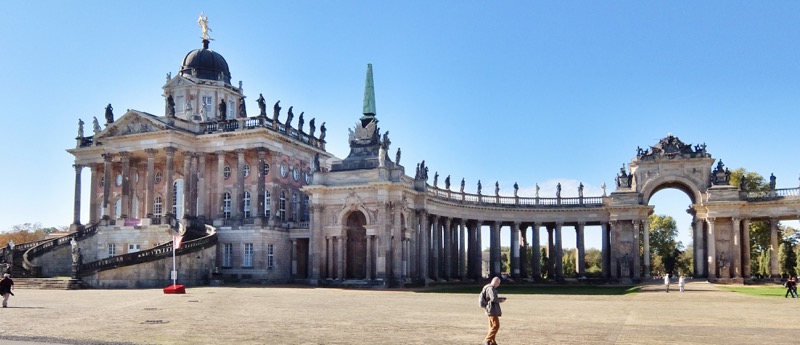
The Neue (new) Palace


With a decorative feature in front, with arch, to frame the vista. And a few rooms for visitors.


A terraced garden with elevated portico for drinks and nibbles perhaps.


A pergola for afternoon tea


And on my way there in the very popular nearby New Park on a sunny Sunday even non-royalty was sans souci.


13 October 2014

German-Russian Museum

There cannot be many museums with these exhibits, unlike the major museums with their masterpieces or Egyptian or Greek sculptures.

It is tucked away in a quiet suburban setting in the former East Berlin (of course).

The museum is the actual building where the formal surrender of WW2 was signed.

In this room.

There was also a complementary signing in Rheims (a city in eastern France in the Champagne Department).


Land mine clearing at a river crossing.

No need for fancy equipment, there are plenty of Jewish women.


There is a pair of sculptures like this in the large Soviet memorial garden.

An artists impression of the storming of the Brandenburg Gate in the final days of the War.

The retreating Germans had a scorched earth policy as they left Russia and Poland on their way back to Germany and Berlin. Towns were burnt and the railway tracks ripped.


Only the historians have a clear understanding of the casualties sustained in the war. This graphic quickly brings it into focus in Europe.


The major losses were the Soviets by far, with civilian losses more than the military.

The Polish civilian losses were also huge being similar to the German military losses.

The Yugoslav losses also included many civilians (I guess they were mostly Roma as the total number of Roma exterminated across Europe and the USSR was comparable to the Jews at about 6 million for each group)


11 October 2014

Museums


Berlin is renown for its Museums. Numerous, extensive in their archives, and many of excellent quality. Clearly another reflection of the depth of thought given to much of German Culture as well as its long-term access to wealth.


I will be in Berlin for some time so have obtained a long-term pass to all of the "State" museums to enable me to browse at my leisure without the usual constraints of the more common 3-day pass.


Yesterday at the Altes Museum, a grand building in the centre of town. Today at the Kultureforum (below) which by comparison has the most bland architecture. "Even" the ordinary church next door (right) was far superior.


The collection of paintings and other works of art was vast and first class. The exhibition at the moment is on Cranach.


Below is an alternative depiction of Adam and Eve with a bit of a Germanic edge.

A young girl engrossed in a classic painting, listening to the audio guide, mother just behind.


A regal procession through 15 century St Peters Square.


And (below) from the same time the well known debauchery of the cardinals.


Squabbling over whose turn?


A contrast to this week's discussions in the Vatican when cardinals were embarrassed to hear personally of the joys of intimacy from an Australian couple in a very long-term marriage. History does get forgotten.


Berlin is known for its erotic clubs and lifestyle. This could be a painting from some of its milder days.


On the way home from the museum, whilst having dinner at the famous Hasir Restaurant (The birthplace of the ubiquitous dönner kebab), another of Berlin's frequent protests, this time against the rather esoteric proposed free trade agreement across the Atlantic.


09 October 2014

Kreuzberg

There is the Thursday indoor Street Market - a good selection of street food.


A missing bike, with even the rear hub cleanly excised from the locked rim.

The kanal

And a summary of life in Berlin, near a door on the way to my local cafe.


Köpenick

"Köpenick is a historic town and locality that is situated at the confluence of the rivers Dahme and Spree."

It is about 11 kms south-east, a short ride, from Kreuzberg. On the way is the Soviet Memorial. This occupies a large space.


Köpenick was worth a short ride. Pretty, photogenic but difficult to get good camera angles.

08 October 2014

Berliner Mauerweg 2

All bike rides need a purpose (some famous French cyclist), so the 2nd stage of my ride around the boundary of the former West Berlin, essentially up the middle of Berlin, was to visit Lübars. "One of the most authentic and oldest villages (1247) in the outskirts of Berlin, it looks the same way it did some hundred years ago." This would date it near the beginning of recorded settlement in Berlin, although not old by European standards.

Dicke Marie


Lübars is located on the northern edge of Berlin and I was expecting to see an old "authentic" village. But what I saw was just a neatly kept peri-urban green location with lots of quality equestrian facilities - a disappointment but a few kms further on to the west I saw

"Dicke Marie"

that is still just alive and as old as those long decayed and absent first buildings in Lübars.


And an interesting bridge.


It is worth highlighting that Berlin has many water based living places, from those on the many kms of kanals and rivers, to those on the various lakes and sees. The next stage of my Mauerweg will continue on the western side of Berlin that has extensive amount of waterside homes and facilities.