Showing posts with label Culture. Show all posts

21 October 2014

German Excellence

German is the home to technical excellence. It is the largest exporter of high technology. Think, where do the machines come from that make good stuff.

At its peak, Berlin was the major industrial city in Europe. It was the major manufacturer, for example, of locomotives in Germany. All that came to an end in WWII, Berlin is now a home to services and so-called creative industries, implying apparently that making locomotives and lots more besides, was not creative.

Excellence however persists of course. For those who have experienced the discomfort of a tram ride in Melbourne as the trams bounce and clunk and squeal, I commend this to you.

An effective, diligent team maintaining the Berlin tram network. The quality-focussed supervisor, the skilled tradesman and the thoughtful assistant. I watched them for a few minutes.

Yarra Trams and Public Transport Victoria could take note. There is no evidence to me that they understand how to maintain tram tracks. Perhaps they could start by tring to think German as probably this is not too costly, it is about attitude and skills.


19 October 2014

no worries

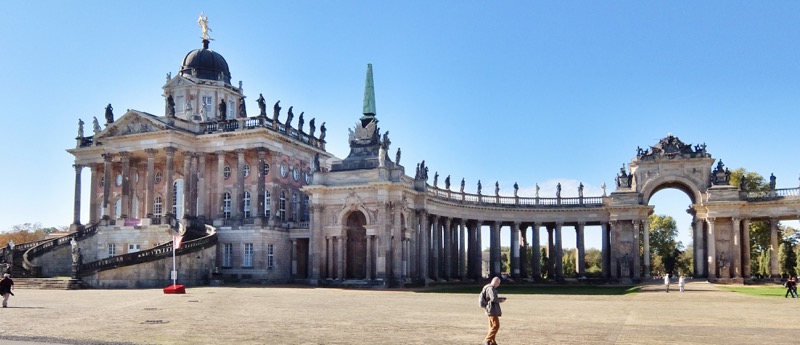
The King of Prussia thought of a country residence where he could enjoy life and relax with no worries, so "Sanssouci" ( why French ? ) was born. He needed a bit of space for the garden so the grounds are a few kms in all directions.

The Neue (new) Palace


With a decorative feature in front, with arch, to frame the vista. And a few rooms for visitors.


A terraced garden with elevated portico for drinks and nibbles perhaps.


A pergola for afternoon tea


And on my way there in the very popular nearby New Park on a sunny Sunday even non-royalty was sans souci.


13 October 2014

German-Russian Museum

There cannot be many museums with these exhibits, unlike the major museums with their masterpieces or Egyptian or Greek sculptures.

It is tucked away in a quiet suburban setting in the former East Berlin (of course).

The museum is the actual building where the formal surrender of WW2 was signed.

In this room.

There was also a complementary signing in Rheims (a city in eastern France in the Champagne Department).


Land mine clearing at a river crossing.

No need for fancy equipment, there are plenty of Jewish women.


There is a pair of sculptures like this in the large Soviet memorial garden.

An artists impression of the storming of the Brandenburg Gate in the final days of the War.

The retreating Germans had a scorched earth policy as they left Russia and Poland on their way back to Germany and Berlin. Towns were burnt and the railway tracks ripped.


Only the historians have a clear understanding of the casualties sustained in the war. This graphic quickly brings it into focus in Europe.


The major losses were the Soviets by far, with civilian losses more than the military.

The Polish civilian losses were also huge being similar to the German military losses.

The Yugoslav losses also included many civilians (I guess they were mostly Roma as the total number of Roma exterminated across Europe and the USSR was comparable to the Jews at about 6 million for each group)


11 October 2014

Museums


Berlin is renown for its Museums. Numerous, extensive in their archives, and many of excellent quality. Clearly another reflection of the depth of thought given to much of German Culture as well as its long-term access to wealth.


I will be in Berlin for some time so have obtained a long-term pass to all of the "State" museums to enable me to browse at my leisure without the usual constraints of the more common 3-day pass.


Yesterday at the Altes Museum, a grand building in the centre of town. Today at the Kultureforum (below) which by comparison has the most bland architecture. "Even" the ordinary church next door (right) was far superior.


The collection of paintings and other works of art was vast and first class. The exhibition at the moment is on Cranach.


Below is an alternative depiction of Adam and Eve with a bit of a Germanic edge.

A young girl engrossed in a classic painting, listening to the audio guide, mother just behind.


A regal procession through 15 century St Peters Square.


And (below) from the same time the well known debauchery of the cardinals.


Squabbling over whose turn?


A contrast to this week's discussions in the Vatican when cardinals were embarrassed to hear personally of the joys of intimacy from an Australian couple in a very long-term marriage. History does get forgotten.


Berlin is known for its erotic clubs and lifestyle. This could be a painting from some of its milder days.


On the way home from the museum, whilst having dinner at the famous Hasir Restaurant (The birthplace of the ubiquitous dönner kebab), another of Berlin's frequent protests, this time against the rather esoteric proposed free trade agreement across the Atlantic.


09 October 2014

Kreuzberg

There is the Thursday indoor Street Market - a good selection of street food.


A missing bike, with even the rear hub cleanly excised from the locked rim.

The kanal

And a summary of life in Berlin, near a door on the way to my local cafe.


07 October 2014

Random Images

These flower boxes stood out in Neukölln.


A sculpture nearby.


05 October 2014

The Wall


On the way to the wall
 

01 October 2014

Berlin 1st impressions

A few days settling in including walking the streets to overcome the usual jet lag. I have been here briefly twice before so I am familiar with the place in the usual superficial sort of way. And also, as I am here for 6 weeks, there is no hurry to race from someone else's ideas of highlight to highlight. This visit will include some of the museums et al, but as the weather is now in its last sunny days of autumn the museums will wait for the colder and rainy days ahead.


I am in a room rented via airbnb in the suburb of Kreuzberg near the border with Neukölln. These are the areas I have been walking.

The park opposite is the local centre for drug dealers - all of African origin and apparently all fairly harmless, they could equally be selling sunglasses or souvenirs if it was a beach or in the centre of town but the locals apparently want drugs. The place also has many Turkish migrants and numerous Turkish places to eat, so all in all a bit rundown but with character and budget food.

My current ritual is up early and a short walk south into Neukölln that is like your average family suburb of 5 story apartments. Good for a morning coffee and to observe the continuous flow of mostly cyclists on their way somewhere - there are many children being taken on bikes presumably to daycare or to their grandparents. This place is good for a morning coffee with the morning sun, but this photo was taken in the afternoon from the cafe across the road with the afternoon sun. You might notice that the bakery is in a building with some character and presumably is one of the minority that survived the bombing - the building to the left is much blander by comparison and clearly post WW2.

And then there is recycling as only the Germans can do it. It is omnipresent. On one of my occasional visit to the usual German supermarket (there are at least 3 chains all clones of each other and distinctly cheaper than Aldi in Australia, and none so far like Woolworths or Coles) I noticed the price I was charged for the bottled mineral water was very much larger than that advertised. It included a large deposit €0.25 per bottle. To receive a refund of the deposit you put the empties into a machine (in every supermarket) that scans the barcode on the bottle (eg type of plastic), crushes the bottles, and then prints a docket to obtain a refund from the cashier.


22 June 2013

Pre-Departure 1

"I set out alone, finding no companion to cheer the way with friendly intercourse, and no party of travellers with whom to associate myself. Swayed by an overmastering impulse within me, and a long-cherished desire to visit those glorious sanctuaries, I resolved to quit all my friends and tear myself away from my home."

Ibn Battuta


24 October 2011

Autumn Riding in Europe

I was reflecting on the differences between my last long ride across Europe in 2008.
A few factors:

  • the days are much shorter
  • the temperature is a bit cooler, meaning there is not much motivation for early starts (after the later sunrise) as it has been quite chilly on some mornings
  • this is a solo ride, so time must be allowed for finding hotels, including the possibility of leaving time to get to the next town sometimes.
  • I am carrying all my stuff rather than it being in a van, slowing the climbs noticeably
  • time is "lost" when slowing, or pausing, to check navigation and sometimes make changes to the intended day's path
  • when feeling tired there is no nearby peleton of fellow riders in which to shelter from the wind.

All these combine to reduce the available hours for cycling and the average speed.
In addition when there are things to see as I often do, so there are more non-riding days.
So rather than a ride across Europe, it is a ride between places of interest when there is likely something to be discovered, and the weather reasonable, otherwise the train.

Currently in Barcelona for 5 nights, including today's day of rain, then south.

And on blogging

I had developed a pattern of writing my blogs at night after dinner whilst alone in my quiet hotel room. The wifi issue interfered with that pattern from time to time. Being on-line to sort out photos and formatting is also important.

Now in Spain. The sunrise is late as they are west but on the same time zone as most of Europe. They live at night and eat late, so the time for blogging needs to be re-thought.

10 October 2011

Itinerary update

The weather has turned, looks windy wet and cooler, so I am on my way to Provence from where I will ride to Barcelona, and beyond. Have hardly ridden for days since 2 ferocious days of headwinds some days back. These days motivated a short train ride to Goslar, then a longer day of trains to Aachen.

Two matters are of some consequence:

1 There is a French train strike.

2. The French school holidays begin on the 23 rd and I suspect it will get busy down south where I will be, so I may not linger depending on accommodation issues. I might have about 8-10 days in France by the time the trains resume and I get there. The key French train web site I want for the overnight bike-friendly trains uses Flash Player which does not work on the iPad.

So as there is no riding to write about, other matters.


In the interim I am in Aachen, immensely important if you have not heard of it. It is the place of coronation for all the Kings / Emperors (Kaisers) since Charlemagne for 600 years, from 936 to 1531, in the Aachen chapel for 30 German kings and 12 queens. Although the Pope had a role in Rome in all of this too. The chapel was not then a Cathedral as it was the palace church without a Bishop. This place was geographically central to his world, and had good hot spa water and forests for hunting.

A bit more of this history is recommended for those contemplating a Cultural Ride across Europe. Cultural understanding requires context, world linkages.

Aachen

For Charlemagne, Aachen was the new Rome. The evidence is that he was a true Romaphile. The Bronze Wolf statue circa 200AD on a pedestal in the palace church. Marble columns bought from Rome. He was the first Emperor since the Roman Empire.

Charlemagne was pivotal in galvanising the Christians into a coherent group of soldiers and stopping the widespread Islamic destruction of Europe that had gone on for centuries.

Charlemagne bought back education that had decreased since the sacking of Rome and the de-ubanisation of Europe that occurred during the Islamic invasion and widespread destruction of cities (and other matters). It was a key part of the foundation upon which the thinkers, painters and writers could develop, as many needed patronage of some sort, I think. All the other activities (with which some are more familiar) of the arts and sciences, creation of Universities, and later de-christianisation of Europe followed.

Today Aachen has a population of 250,000 and a University of 30,000 students embedded in the historic heart of the town, with all the facilities they need for learning and learning about each other. And a busy train station at the start and end of semester, like the day I arrived, and more so when my train broke down and we all scrambled onto the next train with half of the student body's fleet of bicycles.

To Trier (Germany near the Luxembourg / French border) hopefully tomorrow. A place to see and then for easy access to the French Lunea train I want that gets me to Toulon. Toulon is of no interest but it's hinterland is.

06 October 2011

A Bridge near Litomerice & Jara Cimrman

Along the Vltava River a few days back on the 2nd day out of Prague this bridge caught my attention. I think it is a pretty fine example of the creativity of bridge designers. It is only a bridge of modest size but is striking.

In the context of building roads, bridges can get pretty expensive and, with a few exceptions, bridges are almost strictly functional designs with only a minimum of additional cost allowed for the artistic flair. It is the hallmark of bridge designers to blend their creative and functional technical expertise to get an appealing bridge at low cost for the particular site. This bridge is in the Czech Republic with, I suspect, modest resources further adding to the need for low-cost design.

I further suspect putting a column on the cliff side was going to be expensive. This solution with its leaning tower and integrated bridge spanning the cycle path provided an integrated counter-weight of already needed materials to efficiently support the full weight of the bridge over the river from one side. Jára Cimrman would be pleased.

You see, there is more to that story of a few days back in Prague about Jara with his eye-catching inventions. Jara is a fictional character - a pedagogical device for the Czech people and its education system which I have not fully grasped. A quote from Wikipedia:

Czechs, their mentality and their hero

For many Czechs, Jára Cimrman is not only one of many ordinary funny characters. His status in Czech culture is much deeper and complex than it may seem at the first sight, especially for a foreigner. In the view of Czechs, the whole history of the Czech nation represents a struggle with expansive attempts of bigger nations who have always tried to dominate the Central European region and who have considered it their "sphere of interest".

No matter in which situation, Cimrman is always depicted as a determined fighter against the Austro-Hungarian Monarchy, despite the fact that his very name and origin themselves reflect the ethnically mixed nature of the Czech (and Austrian) population. This symbolizes not only a silent resistance of the Czech people against the Soviet occupation but against any form of oppression which have often taken place in the Czech lands.

Over centuries of military occupations and autocracies, the Czechs developed a mentality which allowed them to resist even the toughest opponents, not by force which they usually lacked, but rather by using their brain and tactics. Reinhard Heydrich, when instructing heads of his Prague’s gestapo, warned them that unlike the Poles or the Yugoslavs who are rigid and stubborn and who can be therefore broken by sufficient force, “Czechs are servile and flexible as sticks which first bend down and then whip back when least expected.”

One of the most used, cited, remembered and very well understood phrases in the Czech Republic is associated with Cimrman and we can find its origin in the movie Jára Cimrman Lying, Sleeping. Cimrman, as a teacher in the local school, gave this advice to a group of children standing in front of a pound (fence for cattle), wondering how to get over it. “Children, in your life you will have to face obstacles. Tyrš says: “Jump, climb, but never ever bend down” but I say: “You may bend down too, but then you must straighten up again!”
The self-image of bending down and then straightening up characterizes a wide-spread Czechs' view of the last two centuries of the Czech history.

I am indebted to the Czech woman who chatted to me at his exhibition - I did not see any explanatory notes about him there.

24 September 2011

Prague Museum - Karlin

The district of Karlin in Prague, just east of the tourist centre, has an interesting history, and for me its is where the Museum of Prague is located. Tourists are rare here, the area run-down, so I had the freedom to explore it at my leisure.

The sign said no photos, but we all understand the drill here.

Amongst its notable achievements it is where the foundations of German and Czech primary and secondary schooling were started. The museum is undergoing external renovations, there are more friendly staff than tourists, and I commend it to you - the story follows.