19 October 2014

no worries

The King of Prussia thought of a country residence where he could enjoy life and relax with no worries, so "Sanssouci" ( why French ? ) was born. He needed a bit of space for the garden so the grounds are a few kms in all directions.

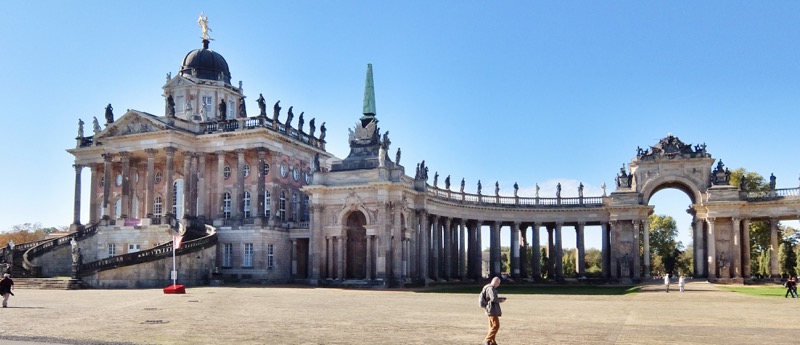
The Neue (new) Palace


With a decorative feature in front, with arch, to frame the vista. And a few rooms for visitors.


A terraced garden with elevated portico for drinks and nibbles perhaps.


A pergola for afternoon tea


And on my way there in the very popular nearby New Park on a sunny Sunday even non-royalty was sans souci.


13 October 2014

German-Russian Museum

There cannot be many museums with these exhibits, unlike the major museums with their masterpieces or Egyptian or Greek sculptures.

It is tucked away in a quiet suburban setting in the former East Berlin (of course).

The museum is the actual building where the formal surrender of WW2 was signed.

In this room.

There was also a complementary signing in Rheims (a city in eastern France in the Champagne Department).


Land mine clearing at a river crossing.

No need for fancy equipment, there are plenty of Jewish women.


There is a pair of sculptures like this in the large Soviet memorial garden.

An artists impression of the storming of the Brandenburg Gate in the final days of the War.

The retreating Germans had a scorched earth policy as they left Russia and Poland on their way back to Germany and Berlin. Towns were burnt and the railway tracks ripped.


Only the historians have a clear understanding of the casualties sustained in the war. This graphic quickly brings it into focus in Europe.


The major losses were the Soviets by far, with civilian losses more than the military.

The Polish civilian losses were also huge being similar to the German military losses.

The Yugoslav losses also included many civilians (I guess they were mostly Roma as the total number of Roma exterminated across Europe and the USSR was comparable to the Jews at about 6 million for each group)


11 October 2014

Museums


Berlin is renown for its Museums. Numerous, extensive in their archives, and many of excellent quality. Clearly another reflection of the depth of thought given to much of German Culture as well as its long-term access to wealth.


I will be in Berlin for some time so have obtained a long-term pass to all of the "State" museums to enable me to browse at my leisure without the usual constraints of the more common 3-day pass.


Yesterday at the Altes Museum, a grand building in the centre of town. Today at the Kultureforum (below) which by comparison has the most bland architecture. "Even" the ordinary church next door (right) was far superior.


The collection of paintings and other works of art was vast and first class. The exhibition at the moment is on Cranach.


Below is an alternative depiction of Adam and Eve with a bit of a Germanic edge.

A young girl engrossed in a classic painting, listening to the audio guide, mother just behind.


A regal procession through 15 century St Peters Square.


And (below) from the same time the well known debauchery of the cardinals.


Squabbling over whose turn?


A contrast to this week's discussions in the Vatican when cardinals were embarrassed to hear personally of the joys of intimacy from an Australian couple in a very long-term marriage. History does get forgotten.


Berlin is known for its erotic clubs and lifestyle. This could be a painting from some of its milder days.


On the way home from the museum, whilst having dinner at the famous Hasir Restaurant (The birthplace of the ubiquitous dönner kebab), another of Berlin's frequent protests, this time against the rather esoteric proposed free trade agreement across the Atlantic.

 

09 October 2014

Kreuzberg

There is the Thursday indoor Street Market - a good selection of street food.


A missing bike, with even the rear hub cleanly excised from the locked rim.

The kanal

And a summary of life in Berlin, near a door on the way to my local cafe.


Köpenick

"Köpenick is a historic town and locality that is situated at the confluence of the rivers Dahme and Spree."

It is about 11 kms south-east, a short ride, from Kreuzberg. On the way is the Soviet Memorial. This occupies a large space.


Köpenick was worth a short ride. Pretty, photogenic but difficult to get good camera angles.

08 October 2014

Berliner Mauerweg 2

All bike rides need a purpose (some famous French cyclist), so the 2nd stage of my ride around the boundary of the former West Berlin, essentially up the middle of Berlin, was to visit Lübars. "One of the most authentic and oldest villages (1247) in the outskirts of Berlin, it looks the same way it did some hundred years ago." This would date it near the beginning of recorded settlement in Berlin, although not old by European standards.

Dicke Marie


Lübars is located on the northern edge of Berlin and I was expecting to see an old "authentic" village. But what I saw was just a neatly kept peri-urban green location with lots of quality equestrian facilities - a disappointment but a few kms further on to the west I saw

"Dicke Marie"

that is still just alive and as old as those long decayed and absent first buildings in Lübars.


And an interesting bridge.


It is worth highlighting that Berlin has many water based living places, from those on the many kms of kanals and rivers, to those on the various lakes and sees. The next stage of my Mauerweg will continue on the western side of Berlin that has extensive amount of waterside homes and facilities.


07 October 2014

Random Images

These flower boxes stood out in Neukölln.


A sculpture nearby.


05 October 2014

Berlin Orientation

BerlinBerlin is a city in one of 3 City States, among the total of 16 States in Germany. It is located at a latitude 52 degrees 30 minutes north. By comparison Melbourne is 35 south and Hobart 43. So at the moment as autumn advances the sun is staying fairly low in the sky and the locals are taking every opportunity to soak up the sun whilst it is still warm.


Berlin is divided into boroughs and subdivided into localities.


The route of the Berliner Mauerweg

A closer look at the inner boroughs. I am in Kreuzberg, soon to be moving to Moabit in Mitte.


The Wall


On the way to the wall
 

04 October 2014

Berliner Mauerweg

After 2 days of walking, that was enough, the bike was assembled. Day 3 was a ride and I enjoyed the freedom we all experience on a bike, presumably the same type of liberation the women of the 19th century enjoyed when they took to cycling and were no longer confined to the walking radius around their european village.

Where to go for my first ride - along the route of the Berlin wall "Berliner Mauerweg ". My apartment is very close to the Mauerweg so I covered about ⅓ of it - approx 60 kms of the southeast part. The total length is 170 km so there will be another 2, possibly 3 days to complete the circumference. Very little remains of the wall and none of it on my first section. The geography/environment clearly identifies most of the wall's route and typically the former West Berlin has better buildings whilst the former East Berlin has blander architecture or open fields, although the other 100km or so not yet seen will be another matter as it includes the section through the city's heart.

There are the occasional information signs to mark points of interest. The location of the 450 espionage tunnel from the west to under an eastern communications centre, the location of the road for the west's garbage trucks to a dump in the east, the border crossing to allow passengers from the west access to the airport in the east (much cheaper airfares, and a source of $US for the east), and poignantly, selected locations with photographs where people were killed whilst attempting a border crossing.

October 2nd was a fitting time to start riding the Berliner Mauerweg. October 3rd is the anniversary of German Unification and a public holiday. This year is the 24th anniversary although the wall was opened nearly 25 years ago in late 1989. The road each side of the Brandenburg Tor (gate) is the site of a Volksfest for a few days. Nothing remarkable, just the usual activities of a fair with German wurst and bier.

I have pretty much settled in, various sundry errands done, all 6 weeks accommodation organised. Some sundry images.

Celebrating German Unification with beer, music and bikes.

 
They have a way with words
 

The kanal near me

A busker with his own handcrafted instrument
 

01 October 2014

Berlin 1st impressions

A few days settling in including walking the streets to overcome the usual jet lag. I have been here briefly twice before so I am familiar with the place in the usual superficial sort of way. And also, as I am here for 6 weeks, there is no hurry to race from someone else's ideas of highlight to highlight. This visit will include some of the museums et al, but as the weather is now in its last sunny days of autumn the museums will wait for the colder and rainy days ahead.


I am in a room rented via airbnb in the suburb of Kreuzberg near the border with Neukölln. These are the areas I have been walking.

The park opposite is the local centre for drug dealers - all of African origin and apparently all fairly harmless, they could equally be selling sunglasses or souvenirs if it was a beach or in the centre of town but the locals apparently want drugs. The place also has many Turkish migrants and numerous Turkish places to eat, so all in all a bit rundown but with character and budget food.

My current ritual is up early and a short walk south into Neukölln that is like your average family suburb of 5 story apartments. Good for a morning coffee and to observe the continuous flow of mostly cyclists on their way somewhere - there are many children being taken on bikes presumably to daycare or to their grandparents. This place is good for a morning coffee with the morning sun, but this photo was taken in the afternoon from the cafe across the road with the afternoon sun. You might notice that the bakery is in a building with some character and presumably is one of the minority that survived the bombing - the building to the left is much blander by comparison and clearly post WW2.

And then there is recycling as only the Germans can do it. It is omnipresent. On one of my occasional visit to the usual German supermarket (there are at least 3 chains all clones of each other and distinctly cheaper than Aldi in Australia, and none so far like Woolworths or Coles) I noticed the price I was charged for the bottled mineral water was very much larger than that advertised. It included a large deposit €0.25 per bottle. To receive a refund of the deposit you put the empties into a machine (in every supermarket) that scans the barcode on the bottle (eg type of plastic), crushes the bottles, and then prints a docket to obtain a refund from the cashier.