Showing posts with label Germany. Show all posts

30 October 2014

Living in Berlin


Above is a photo of an ICE train at the Hauptbahnhof.

The season is clearly turning with many scenes of autumn colours along the canal.

These words are flowing beside an image of the canal with cycle trail a few hundred metres from my hotel.


A few of my friends had doubted the authenticity of the photo of my previous B&B so below is the image of my current hotel — clearly a step up.


Bicycle parking of course.


Breakfast is included.


The current hotel is clearly an upgrade from the accommodation on this site in previous times.

Clothing has changed with the scarcity of fur following the widespread hunting in such places as the nearby Grosse Tiergärten which was the King's private extensive large game hunting grounds, extending west from the tourst Mecca of the Brandenburg Gate. The Tiergärten was a forest that was completely chopped down for firewood after WWII.

22 October 2014

Havel River

On mentioning that I had visited Potsdam recently, I was asked "That is a port isn't it?", to which I remarked "No, it is famous in German history as a place for kings and the Potsdam Agreement of 1945 between the 3 allies".

Well the person that asked me knew her Slavic history much better than I. So whilst my answer was partly correct, and Potsdam today exudes the regal excesses of recent centuries and the luxury boats on the water today, I clearly was ignorant of its beginnings.

Potsdam is built on the Havel River on the Templiner See, a particularly wide part of the river more like a lake, downstream of the Wannsee.


In earlier Greek or Latin sources, such as Tacitus' Germania, the name of the river was also written as Habola, Habula, Havela. The river name Havel is related to German Haff, habe, hafen, MHG Hafen meaning port, harbor).

The Slavic people who later moved into the Havel river area were referred to in German sources as Heveller (occasionally as Havolane). The Havel River, with its tributary the Spree, feed into the Elbe that flows to the North Sea. This water system has obviously been a major trade route from the earliest settlements of Germania including ports at Berlin, Spandau, Potsdam and numerous other places. However you need to have a trained eye to see much evidence of that history today overtaken by tourist and pleasure craft except for the odd barge carrying odds and sods about.

Among others, there are four important bridges, in Spandau, in Potsdam, in (The City of) Brandenburg and in a western suburb of that town.

This is the famous Gleinecke Bridge at Potsdam across which spies were exchanged during the Cold War


It has its own Brandenburg Gate.


The city of Spandau is upstream of Potsdam and was founded at the confluence of the rivers Spree and Havel. The settlement of the area can be traced back to the sixth century when the eastern territories of the Elbe river were populated by several Slavic tribes. The history of Spandau begins in the 7th century or 8th century, when the Slav Hevelli settled in the area and later built a fortress there. It was conquered in 928 by the German King Henry I, but returned to Slavic rule after the rebellion of 983.

In 1156, the Ascanian count Albert the Bear took possession of the region and is believed to have established a fortress here, from which the name Spandau originated. It was around this fortress that the city of Spandow developed, becoming the centre of the entire region (predating Berlin) .

1197 marked the first mention as Spandowe in a deed of Otto II, Margrave of Brandenburg – thus forty years earlier than the Cölln part of medieval Berlin. Spandau was given city rights in 1232.

During the Ascanian Rule the construction of the Spandau Citadel began, which was completed between 1559 and 1594 by Joachim II of Brandenburg. In 1558 the village of Gatow became part of Spandau. During the Thirty Years' War Spandau was surrendered to the Swedes in 1634.

In 1806, after the Battle of Jena and Auerstedt, French troops under Napoleon took possession of the city and stayed there until 1807. In 1812, Napoleon returned and the Spandau Citadel was besieged in 1813 by Prussian and Russian troops.

From 1849 on the poet and revolutionary Gottfried Kinkel had been an inmate of the Spandau town prison, until he was freed by his friend Carl Schurz on the night of November 6, 1850

Before World War I, Spandau was a seat of large, government, cannon foundries, factories for making gunpowder, and other munitions of war making, it a centre of the arms industry in the German Empire. It was also a garrison town with numerous barracks, home of the 5th Guards Infantry Brigade and the 5th Foot Guards of the German Army. In 1920, the independent city of Spandau (whose name had been changed from Spandow in 1878) was incorporated into Greater Berlin as a borough.

After World War II until 1990, when Berlin was divided into four sections administered by the victorious Allies, Spandau was part of the British Occupation Sector in West Berlin. The Spandau Prison, built in 1876, was used to house Nazi war criminals who were sentenced to imprisonment at the Nuremberg Trials. After the death of its last inmate, Rudolf Hess in 1987, Spandau Prison was completely demolished by the allied powers and later replaced by a shopping mall.


A day strolling into Mitte


At the City Kindergärten

A Jewish building.

The main train station. No trains terminate here.

The visible platforms are elevated. There is another set of platforms underground at right angles to these platforms and the underground tracks go under the river Spree.


21 October 2014

German Excellence

German is the home to technical excellence. It is the largest exporter of high technology. Think, where do the machines come from that make good stuff.

At its peak, Berlin was the major industrial city in Europe. It was the major manufacturer, for example, of locomotives in Germany. All that came to an end in WWII, Berlin is now a home to services and so-called creative industries, implying apparently that making locomotives and lots more besides, was not creative.

Excellence however persists of course. For those who have experienced the discomfort of a tram ride in Melbourne as the trams bounce and clunk and squeal, I commend this to you.

An effective, diligent team maintaining the Berlin tram network. The quality-focussed supervisor, the skilled tradesman and the thoughtful assistant. I watched them for a few minutes.

Yarra Trams and Public Transport Victoria could take note. There is no evidence to me that they understand how to maintain tram tracks. Perhaps they could start by tring to think German as probably this is not too costly, it is about attitude and skills.


To Mitte along the Spree

19 October 2014

no worries

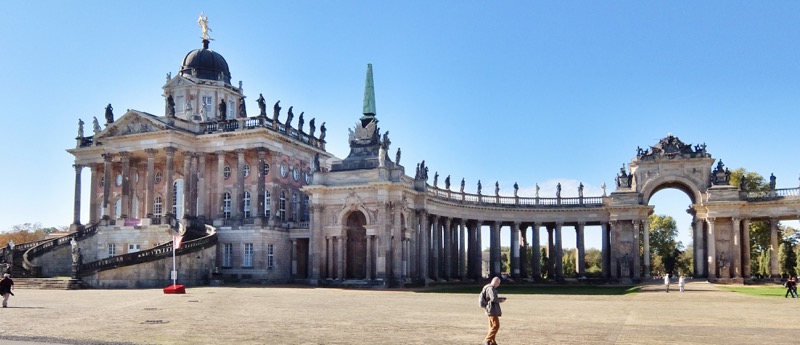
The King of Prussia thought of a country residence where he could enjoy life and relax with no worries, so "Sanssouci" ( why French ? ) was born. He needed a bit of space for the garden so the grounds are a few kms in all directions.

The Neue (new) Palace


With a decorative feature in front, with arch, to frame the vista. And a few rooms for visitors.


A terraced garden with elevated portico for drinks and nibbles perhaps.


A pergola for afternoon tea


And on my way there in the very popular nearby New Park on a sunny Sunday even non-royalty was sans souci.


13 October 2014

German-Russian Museum

There cannot be many museums with these exhibits, unlike the major museums with their masterpieces or Egyptian or Greek sculptures.

It is tucked away in a quiet suburban setting in the former East Berlin (of course).

The museum is the actual building where the formal surrender of WW2 was signed.

In this room.

There was also a complementary signing in Rheims (a city in eastern France in the Champagne Department).


Land mine clearing at a river crossing.

No need for fancy equipment, there are plenty of Jewish women.


There is a pair of sculptures like this in the large Soviet memorial garden.

An artists impression of the storming of the Brandenburg Gate in the final days of the War.

The retreating Germans had a scorched earth policy as they left Russia and Poland on their way back to Germany and Berlin. Towns were burnt and the railway tracks ripped.


Only the historians have a clear understanding of the casualties sustained in the war. This graphic quickly brings it into focus in Europe.


The major losses were the Soviets by far, with civilian losses more than the military.

The Polish civilian losses were also huge being similar to the German military losses.

The Yugoslav losses also included many civilians (I guess they were mostly Roma as the total number of Roma exterminated across Europe and the USSR was comparable to the Jews at about 6 million for each group)


11 October 2014

Museums


Berlin is renown for its Museums. Numerous, extensive in their archives, and many of excellent quality. Clearly another reflection of the depth of thought given to much of German Culture as well as its long-term access to wealth.


I will be in Berlin for some time so have obtained a long-term pass to all of the "State" museums to enable me to browse at my leisure without the usual constraints of the more common 3-day pass.


Yesterday at the Altes Museum, a grand building in the centre of town. Today at the Kultureforum (below) which by comparison has the most bland architecture. "Even" the ordinary church next door (right) was far superior.


The collection of paintings and other works of art was vast and first class. The exhibition at the moment is on Cranach.


Below is an alternative depiction of Adam and Eve with a bit of a Germanic edge.

A young girl engrossed in a classic painting, listening to the audio guide, mother just behind.


A regal procession through 15 century St Peters Square.


And (below) from the same time the well known debauchery of the cardinals.


Squabbling over whose turn?


A contrast to this week's discussions in the Vatican when cardinals were embarrassed to hear personally of the joys of intimacy from an Australian couple in a very long-term marriage. History does get forgotten.


Berlin is known for its erotic clubs and lifestyle. This could be a painting from some of its milder days.


On the way home from the museum, whilst having dinner at the famous Hasir Restaurant (The birthplace of the ubiquitous dönner kebab), another of Berlin's frequent protests, this time against the rather esoteric proposed free trade agreement across the Atlantic.